Sourcing Dust Free Cat Litter is not simply a matter of choosing the cleanest-looking package. It requires careful checking of materials, production controls, testing records, and customer needs. A supplier may claim “dust free,” yet the product can still release fine particles during pouring or scooping. That difference matters in real homes, where litter is handled near food bowls, carpets, and children.
Dr. Bruce Elsey, veterinarian and founder of Precious Cat, has emphasized a practical truth: “Cats are very particular about their litter.” Buyers should remember that point when comparing clumping litter, silica products, wood pellets, and plant-based formulas. Low dust is valuable, but cats also judge texture, scent, moisture control, and box cleanliness. A strong product must satisfy both the animal and the person cleaning the tray.
Look closely at the supply chain. Request recent laboratory results, particle-control information, ingredient details, and production samples from each factory. Test the litter in ordinary conditions. Pour it from shoulder height, scoop it under bright light, and inspect the surrounding floor. The answer may look less perfect than the sales sheet. That is useful.
Packaging deserves attention too. Weak seals can allow moisture into otherwise reliable litter. Oversized bags may reduce unit costs but create handling problems for retailers and customers. Ask how the supplier manages batch consistency, complaints, and product recalls. These questions can feel inconvenient. They also protect your reputation.
A dependable sourcing decision balances measurable dust performance with feline acceptance, packaging strength, transparent documentation, and responsive service. There is no effortless shortcut. Careful testing usually reveals the truth.
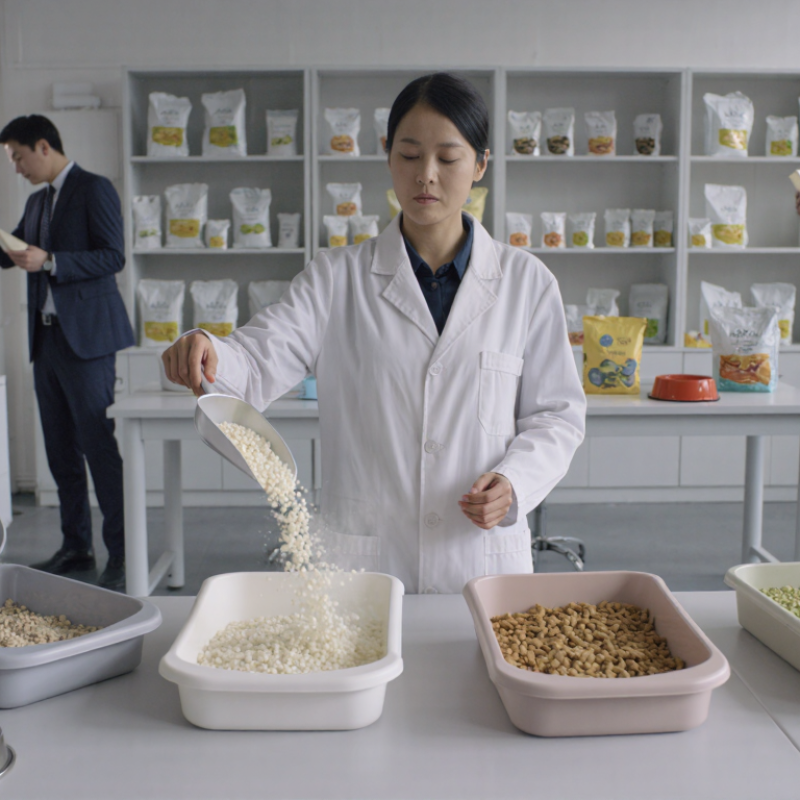
Dust-free cat litter means litter designed to release minimal airborne particles during pouring, scooping, and use. It does not mean absolutely zero dust. That distinction matters when setting customer expectations. In practical sourcing work, I check the litter under bright warehouse lighting. Fine clouds can reveal weak screening or excessive breakage. Independent particle testing, batch records, and clear material specifications provide stronger evidence than a simple “dust-free” claim.
For businesses, lower dust can improve the user experience in homes, shelters, and multi-cat facilities. It may help keep floors, furniture, and nearby air cleaner. Staff may also spend less time wiping dusty shelves and displays. Consistent granule size supports easier scooping and more predictable product performance. Packaging quality matters too. A torn bag can create dust before the product reaches the customer. Still, low dust alone does not prove excellent absorption or odor control. I have seen attractive samples perform poorly after several days of real use.
Tips: Request samples from different production batches. Pour each sample from the same height and inspect the air and floor afterward. Ask suppliers for independent dust-test results, moisture data, and quality-control procedures. Check whether packaging protects the litter during transport. Record absorption, tracking, clumping, and odor performance in a simple test sheet. Do not rely only on supplier photographs. A small weakness may appear only after repeated handling.
Reliable sourcing begins with supplier verification, not attractive packaging. APPA’s 2024 industry data indicates that about 49 million U.S. households own cats. That broad customer base expects clean, low-dust products. Request factory audit records, recent batch samples, safety data sheets, and particle-emission test results. Ask how dust is measured, because “dust-free” is often a marketing phrase rather than an absolute condition.
Test several product types in real settings. Clumping clay usually offers strong odor control and easy waste removal, but its weight can increase freight costs. Plant-based litter is lighter and may appeal to sustainability-focused buyers. Silica-based products can provide long service life, although texture preferences vary. Grand View Research identifies clumping litter as a major market segment, while also reporting continued interest in alternative materials. Data helps, but customer trials matter more.
Use a small pilot order before signing a long contract. Check broken granules, tracking, absorption, odor performance, and dust around the bag opening. Compare results after seven days, not one afternoon. A supplier should explain raw-material sources, moisture controls, packaging limits, and replacement procedures. I would also review delivery consistency across three shipments. One good sample proves little. No supplier is perfect. My own mistake would be judging dust only in a warehouse, where ventilation hides problems. Ask for independent laboratory evidence, then repeat the test with your actual packaging and distribution conditions.
| Product Type | Typical Material | Typical Dust-Control Features | Absorption / Clumping | Suitable Particle Profile | Best Business Applications | Supplier Documents to Request | Key Verification Points |
|---|---|---|---|---|---|---|---|
| Low-dust bentonite clumping litter | Sodium bentonite clay | Screened granules, controlled drying, reduced fines, and sealed packaging | Strong liquid absorption with firm clumps; performance varies by clay grade | Medium to fine granules; a balanced size generally reduces tracking and airborne fines | High-volume retail, multi-cat households, and private-label products | Safety data sheet, certificate of analysis, sieve-size report, moisture data, and test sample | Check dust after pouring and scooping, clump strength, odor performance, and consistency between batches |
| Silica crystal litter | Amorphous silica gel | Low-fines crystal selection and controlled particle sizing | High moisture uptake; usually absorbs liquid without forming traditional clumps | Medium crystals with limited powder content | Premium retail, compact packaging, and customers seeking extended use | SDS, material specification, particle-size distribution, moisture-absorption test, and compliance statement | Confirm that the material is amorphous silica gel, assess sharp edges, monitor tracking, and review disposal requirements |
| Tofu-based litter | Compressed soybean fiber or plant-based residue | Low-fines extrusion, dry storage, and sealed moisture-resistant bags | Generally clumping; absorption depends on fiber density and pellet structure | Short or medium cylindrical pellets with limited loose powder | Eco-conscious retail, subscription boxes, and premium positioning | Ingredient declaration, SDS, moisture content, microbial test, biodegradability evidence, and sample | Test odor retention, clump drying time, pellet breakage, moisture resistance, and susceptibility to insects or mold |
| Wood pellet litter | Compressed softwood or hardwood fibers | Screened pellets and low-breakage production help limit sawdust fines | Absorbs moisture and gradually breaks down; generally non-clumping | Firm pellets with low percentage of broken material | Eco-focused stores, shelters, and customers preferring low-tracking formats | Wood source statement, SDS, moisture data, additive declaration, pest-control statement, and sample | Check resin or fragrance additives, pellet durability, storage stability, odor control, and disposal guidance |
| Corn or wheat-based litter | Processed corn, wheat, or grain-derived fiber | Granule screening, controlled drying, and sealed packaging | Usually clumping with moderate to high absorption, depending on formulation | Medium granules or small pellets with low powder content | Plant-based product lines and mid-to-premium retail ranges | Ingredient statement, SDS, moisture and microbial tests, allergen information, and sample | Evaluate odor changes during storage, clump integrity, pest risk, dust after transport, and disposal claims |
| Paper-based litter | Recycled paper fibers or paper pellets | Large, lightweight pellets generally produce less airborne dust than fine granules | Absorbent; commonly non-clumping, although some formulations are designed to clump | Large, soft pellets with minimal loose fiber | Kittens, sensitive households, veterinary settings, and low-tracking product lines | Recycled-content statement, SDS, additive declaration, moisture data, microbial test, and sample | Review wet-pellet breakdown, odor control, absorbency rate, package compression, and dust from handling |
Dust control should begin with measurable testing, not a supplier’s “low-dust” claim. APPA’s 2023–2024 National Pet Owners Survey counted about 46.5 million U.S. cat-owning households. That scale makes respiratory comfort a serious purchasing factor. Request particle testing after pouring, scooping, and box movement. NIOSH lists 5 mg/m³ as the respirable exposure limit for particulates not otherwise regulated. This is a useful workplace reference, not a cat-litter certification. A clear sample jar, a dark test surface, and a ten-second pour can reveal visible dust quickly.
Safety requires more than dust control. Check ingredient declarations, heavy-metal screening, microbial controls, and safety data sheets. Avoid vague “natural” claims. Ask whether the litter contains added fragrance, and test its pH near a cat’s paws. Absorption should be measured by liquid uptake per kilogram, clump strength, and drying time. A product may absorb quickly but crumble during scooping. That wastes material.
Odor performance needs controlled comparison. Use equal litter depths, identical urine simulant volumes, and fixed observation times. Evaluate ammonia odor after 24 and 72 hours. Grand View Research’s 2024 cat-litter market analysis identifies odor control and clumping performance as important market drivers. Still, laboratory scores can disappoint in a small apartment. I would repeat tests with real household conditions, including humidity and poor ventilation. Perfect results are unlikely. Supplier consistency matters more. Ask for three production-batch samples, not one polished sample.
How to Source Dust Free Cat Litter for Your Business?
Demand is growing, but “dust free” should never remain a vague promise. Grand View Research projects the global cat litter market to grow at about 4.8% annually from 2024 to 2030. That growth attracts inconsistent suppliers. Request a recent certificate of analysis for every material batch. Check particle size, moisture, odor control, and dust emissions separately. A supplier’s internal test may not match your warehouse reality. Ask for independent laboratory results covering fine particles, heavy metals, and microbiological safety. During sampling, pour litter from shoulder height into a clean tray. Watch the air near a dark surface. It reveals more than glossy product photographs.
Packaging affects both quality and landed cost. Select sealed, moisture-resistant bags with readable net weights, batch codes, production dates, and storage instructions. Confirm carton strength through drop testing, especially for pallet shipments. The American Pet Products Association reports that 66% of U.S. households owned a pet in 2023–2024, supporting steady retail movement but also intense price comparison. Request pricing at several volumes, including sample, trial, and container quantities. Compare product cost, packaging, inland freight, inspection fees, and waste allowances. The cheapest quote can become expensive after leakage.
Minimum orders need practical negotiation. Start with a pilot order large enough to test repeat demand, but small enough to limit aging stock. Ask whether the supplier can mix packaging formats or stagger deliveries. Clarify lead times, replacement terms, and payment milestones in writing. I would not trust a perfect first sample alone. Batch variation still happens. Keep retained samples and record dust observations from each shipment.
Sourcing dust-free cat litter requires more than comparing unit prices. Build supplier relationships around measurable specifications, stable quality, and realistic delivery capacity. Request recent batch samples and review dust levels, moisture, particle size, odor control, and packaging strength. A third-party laboratory can verify key results when internal testing is limited. Ask suppliers how they manage raw materials, production waste, and transport distances. Regional sourcing may reduce freight emissions and shorten replenishment times, but it can also limit material availability.
Inventory planning should reflect seasonal demand, warehouse conditions, and supplier lead times. Store pallets off the floor and protect them from humidity, especially when packaging uses paper-based materials. Use batch numbers and receiving dates for traceability. A simple first-in, first-out system can reduce aging stock and packaging damage.
Keep safety stock based on actual demand patterns, not guesswork. Our first forecast was too optimistic, leaving storage space unused. Reviewing sales weekly would have exposed that mistake earlier. Sustainable plans need revision.
Tips: Set a reorder point for each product type. Track damaged bags separately. Check supplier performance every quarter. Combine deliveries only when storage capacity allows. Ask for packaging improvements, but test new materials before changing the full inventory. Small adjustments often work better than ambitious targets that the warehouse cannot support.
Request factory audit records, recent batch samples, safety data sheets, and particle-emission test results. Ask how dust is measured. “Dust-free” may be only a marketing phrase. Review three production batches before signing a long contract.
Clumping clay usually supports odor control and simple waste removal. Plant-based litter is lighter and may attract sustainability-focused buyers. Silica-based litter can last longer, but texture preferences vary. Customer trials often reveal more than market data.
Test broken granules, tracking, absorption, odor performance, and dust near the bag opening. Compare results after seven days, not one afternoon. Check several bags. One good sample proves little.
Observe dust after pouring, scooping, and moving the box. Use a clear sample jar and dark test surface. A ten-second pour can expose visible particles. Repeat testing in your actual packaging and warehouse conditions.
Request ingredient declarations, heavy-metal screening, microbial controls, and safety data sheets. Ask whether fragrance is added. Test pH near a cat’s paws. Avoid vague “natural” claims without supporting evidence.
Measure liquid uptake per kilogram, clump strength, and drying time. Use equal litter depths and identical liquid volumes. Some products absorb quickly but crumble during scooping. That creates waste.
Use fixed observation times, equal litter depths, and controlled liquid volumes. Check ammonia odor after 24 and 72 hours. Repeat tests in humid, poorly ventilated rooms. Laboratory results may disappoint in small apartments.
Set reorder points for each product type and track damaged bags separately. Store pallets off the floor and protect paper packaging from humidity. Record batch numbers and receiving dates. Use first-in, first-out rotation. Keep revising forecasts.
Sourcing Dust Free Cat Litter successfully begins with understanding what “dust-free” means in practical terms: a litter designed to minimize airborne particles during pouring, scooping, and daily use. For businesses, this can improve customer satisfaction, support a cleaner retail environment, and create opportunities to serve households seeking convenient, low-mess pet care products. Buyers should compare reliable suppliers and evaluate suitable product types according to their target market, including considerations such as texture, clumping ability, material, and intended usage.
Before placing an order, assess dust-control performance, safety information, liquid absorption, odor management, and consistency between batches. It is also important to verify quality procedures, packaging strength, labeling accuracy, pricing, production capacity, and minimum order requirements. A sustainable sourcing plan should include supplier communication, sample testing, realistic demand forecasts, inventory rotation, and backup supply options. By balancing product performance, cost, storage needs, and responsible purchasing practices, businesses can build a dependable Dust Free Cat Litter supply program that supports long-term customer trust and operational efficiency.