Kurtuluş, Sami Yücel Cd. No:44/2, Fatsa / Ordu – Türkiye +90 (452) 716 52 52 [email protected]
0%

Choosing among the top customizable granule cat litter suppliers takes more than comparing price lists. Buyers need to examine the product and the supplier’s ability to deliver consistent specifications. Customizable Granule Cat Litter may vary in material, granule size, dust level, absorption, clumping behavior, and odor control. Those differences matter. A bag that pours cleanly in a warehouse can still disappoint in a home if cats reject its texture.

Cat behaviorist Dr. Mikel Delgado’s guidance can be paraphrased this way: “Choose a litter your cat will reliably use, not simply the product with the strongest claims.” That principle keeps the animal in the buying decision. For each supplier, request samples and compare granule shape, dust in a clear container, and performance after a small amount of liquid is added. Ask for written specifications, quality-control procedures, available packaging, minimum order quantities, and realistic lead times. Verify that customized batches match the approved sample.

Details count. A lot. Yet supplier brochures rarely reveal every weakness. A sample may perform differently from a full production run, and “low dust” can mean different things without a shared test method. Buyers should record trial results and confirm agreed tolerances before placing large orders. This guide helps procurement teams compare suppliers with practical questions, not polished promises. The best partner is not always the one offering the longest customization list. It is the one that can explain its process, document consistency, and respond clearly when something needs improvement.
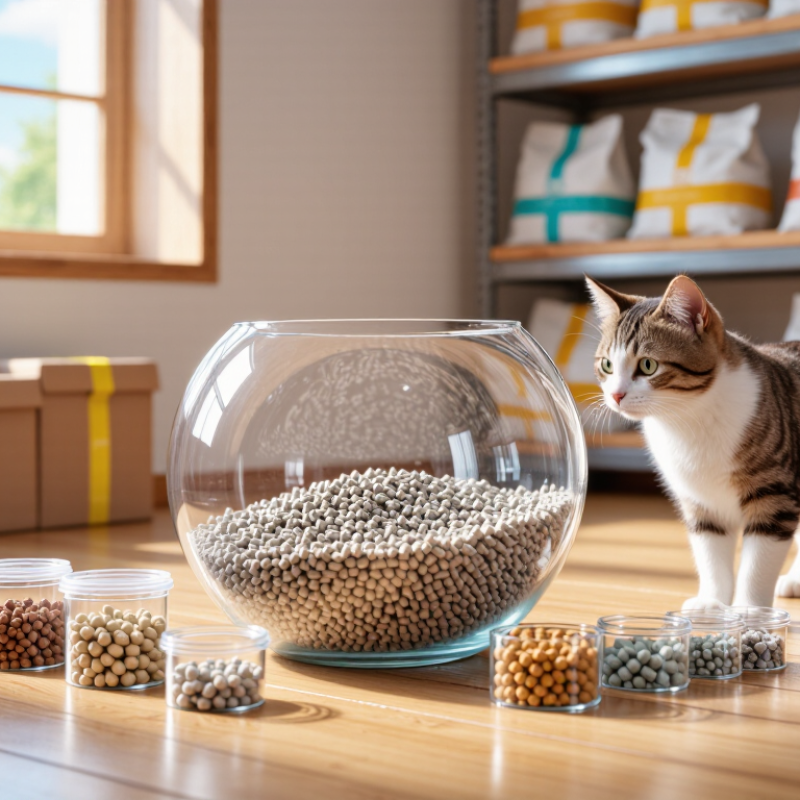
Top Customizable Granule Cat Litter Suppliers for Buyers

Cat Litter Granule Types: Compare 4 Material Families and Their Trade-Offs

Granule material changes more than texture; it affects weight, dust, absorption, and disposal preferences. Bentonite clay commonly forms firm clumps, which can simplify daily scooping. Its heavier granules may increase shipping costs, while fine particles can track beyond the tray. Silica crystal litter is light and absorbs moisture, but some cats dislike its crisp feel underfoot. Crystal size and shape matter. A low-dust claim is worth checking against a sample, not just a product sheet.

Wood and paper granules offer a softer, often lighter alternative, though moisture can break pellets down unevenly. Plant-based granules, such as corn or other fibers, vary widely in clumping strength and odor control. Some are easy to scoop; others soften into residue. No material wins every test. For buyers comparing suppliers, request samples in the intended granule size and test them with the same litter depth, tray, and cleaning routine. Note dust after pouring, tracking on a nearby mat, and clump firmness after several minutes. Customization can cover particle diameter, color, fragrance, and packaging, but every change may affect performance. A small trial is useful. It is not a perfect prediction of repeat orders, either.

Granule Performance Data: Measure Particle Size, Bulk Density, and Absorption

Granule performance should be measured, not judged by appearance alone. Sieve a representative sample and report the percentage in each size band, including fines. ASTM E11 provides recognized sieve specifications for particle-size testing. A practical supplier comparison might track the share below 0.5 mm and above 4 mm, but these are screening bands, not universal quality limits. Small shifts matter. Fines can create dust, while oversized pieces may feel rough under a scoop.

Measure loose bulk density in a fixed-volume cylinder, using the same filling and leveling method for every sample. ASTM D7481 offers a reference method for loose and tapped powder density; adapt it carefully for litter granules and document the procedure. The USGS Mineral Commodity Summaries 2024 reports U.S. bentonite output of roughly 4 million metric tons in 2023. That scale signals a mature mineral supply, not consistent finished-litter performance. For absorption, weigh dry granules, add a fixed water volume, then record retained liquid and clump strength after a set time. Results depend on test conditions, so state them clearly.

Tips: Test three samples from separate bags or production lots. Record moisture, sieve sizes, density, and absorption time. One limitation: a tidy lab result may not match a dusty, humid warehouse. Keep the raw data and retest when a supplier changes material or process.

Supplier Compliance: Check ISO 9001:2015, SDS, and Batch-Level COAs

For customizable granule cat litter, supplier compliance should be checked against the exact product being quoted. Request the ISO 9001:2015 certificate and confirm its scope covers the relevant manufacturing site and processes. Check the issuing body and validity dates, too. ISO certification indicates a quality management system; it does not prove that every batch meets your specifications. Details matter.

Ask for the current Safety Data Sheet (SDS) for the proposed formula, not a generic document for another litter type. Review its listed ingredients, handling guidance, dust information, and revision date. If the supplier changes granule size, mineral blend, or additives, ask whether the SDS needs updating. This step can feel routine, but outdated paperwork is easy to miss.

Request a batch-level Certificate of Analysis (COA) before approving an order. It should show the lot number, test date, methods, measured results, and agreed limits for relevant properties such as moisture, granule size, or bulk density. Match the COA lot number to the packaging and shipping records. If results look unusually uniform, ask how samples were collected and tested. Paperwork helps, but it cannot replace a clear specification and a retained sample for comparison.

Customization and Sourcing: Compare MOQ, Lead Time, Packaging, and FOB Cost

For buyers comparing customizable granule cat litter suppliers, request MOQ, production lead time, packaging specifications, and FOB cost in one quotation. Grand View Research valued the global cat litter market at USD 5.41 billion in 2023 and forecast 5.8% annual growth through 2030. That expanding market does not guarantee flexible factory terms. Ask whether the MOQ applies to one formula, one bag size, or a mixed shipment. A 10-kilogram bag may need a different print run from a 5-kilogram bag. Small details matter.

Lead time should separate sample approval, packaging production, and litter manufacturing. Ask for dates, not “about one month.” For packaging, confirm bag material, seal type, pallet pattern, and whether printed artwork has a separate minimum. FOB quotations also need a named port and a clear list of included charges. Compare the same granule size, moisture level, and packaging weight across suppliers; otherwise, the cheapest quote may not be comparable. I have seen tidy cost sheets hide slow artwork approval. That part is easy to overlook. Supplier-specific MOQ and lead-time figures are not industry-wide standards, so verify them with a dated quote and a production schedule.

Buyer Scorecard: Rate Suppliers on 5 KPIs for Dust, Clumping, Odor, Yield, and QA

A buyer scorecard makes supplier comparisons more practical than relying on a polished product sheet. For customizable granule cat litter, rate dust, clumping, odor control, yield, and quality assurance on the same scale. Test equal quantities in identical trays, and record the room conditions, litter depth, and time between cleaning. Small differences matter. A dusty pour may leave a visible film on a dark surface, while weak clumps can break during scooping.

For dust, observe pouring and scooping. For clumping, check whether a damp sample lifts cleanly after a consistent waiting period. Odor control needs a longer trial; note both the room’s smell and how quickly it returns. Yield can be measured by weighing litter used and waste removed over several days. Ask suppliers for batch records, inspection procedures, and advance notice of material or granule changes. A neat sample is not proof of consistent production. I’ve seen scorecards look convincing, yet testing conditions were not controlled well enough.

Tips: Set a minimum pass mark for each KPI, not just a combined average. Keep one sealed sample from every shipment for comparison. Re-test when granule size, packaging, or source material changes. Scores are useful, but they are not perfect; note uncertainty rather than forcing a confident rating.

FAQS

How should granule size be measured?

Sieve a representative sample and record the percentage in each size band, including fines. Track the shares below 0.5 mm and above 4 mm. These are comparison bands, not universal quality limits.

Why do fines and oversized granules matter?

Fines can create dust during pouring. Oversized pieces may feel rough against a scoop. Appearance alone can mislead.

How can bulk density be compared fairly?

Use a fixed-volume cylinder and the same filling and leveling method for each sample. Record the procedure, because small handling differences can affect results.

What is a practical way to test absorption?

Weigh dry granules, add a fixed water volume, then measure retained liquid after a set time. Also record clump strength. Test conditions matter.

How many samples should buyers test?

Test three samples from separate bags or production lots. Record moisture, sieve sizes, density, and absorption time. Retain the raw data.

What supplier documents should be requested?

Request a current quality-system certificate, a product-specific Safety Data Sheet, and a batch-level Certificate of Analysis. Check the site scope and document dates. Paperwork is not proof by itself.

What should a batch-level analysis report include?

It should show the lot number, test date, methods, measured results, and agreed limits. Match its lot number to packaging and shipping records. Keep a retained sample.

What details belong in a supplier quotation?

Request minimum order quantity, production lead time, packaging specifications, and FOB cost. Confirm whether the minimum applies to one formula, bag size, or mixed shipment.

How can quotations be compared accurately?

Compare the same granule size, moisture level, and packaging weight. Confirm the named port and included charges. Ask for dated production and artwork schedules. A neat price sheet can still hide delays.

Conclusion

Choosing a reliable supplier of Customizable Granule Cat Litter starts with comparing four material families and their trade-offs in comfort, absorbency, clumping, odor control, and handling. Buyers should request clear performance data, including particle-size distribution, bulk density, and absorption capacity, so products can be assessed against intended use and shipping requirements. Supplier documentation also matters: review quality-management credentials such as ISO 9001:2015, current safety data sheets (SDS), and batch-level certificates of analysis (COAs).

Before placing an order, compare minimum order quantities, production lead times, packaging options, and FOB costs, and confirm how customization requests are sampled and approved. A consistent scorecard helps keep decisions objective: rate each supplier on dust, clumping, odor control, yield, and quality assurance. Together, these checks help buyers balance product performance, supply reliability, and cost while selecting a granule specification that fits their market and operational needs.


Amelia

Amelia

Amelia is a dedicated marketing professional with a strong understanding of product strategy, customer needs, and market trends. As a valued member of our team, she regularly contributes expert articles to the company website, sharing practical insights, educational guidance, and thoughtful......