Choosing the best White Bentonite Cat Litter from China requires more than checking its color or advertised clumping speed. A reliable product should form firm, compact clumps, control odor, produce limited dust, and remain comfortable under sensitive paws. The clay’s sodium bentonite content, particle size, moisture level, and processing method can affect daily performance. These details matter beside the litter box.
Dr. Bruce Elsey, a veterinarian and cat-litter specialist, has often emphasized, “The best litter is the one your cat will use.” His practical point remains important for buyers comparing Chinese suppliers. A bright-white appearance may look clean, but it does not prove superior absorbency or safety. Look for documented mineral testing, consistent batch records, dust-control procedures, and transparent factory information. Independent laboratory results can strengthen confidence, especially for odor control and heavy-metal screening.
Real-world testing still matters.
Place a small amount in a separate tray. Observe clump strength, tracking, dust, and your cat’s reaction for several days. Some products appear excellent during a supplier demonstration yet crumble after repeated use. That difference can increase waste and create muddy paw prints across the floor. I would also avoid choosing solely by the lowest quoted price. Cheap transport, moisture exposure, or inconsistent granules may reduce the product’s actual value.
There is no universal winner. The best White Bentonite Cat Litter balances mineral quality, manufacturing consistency, cat acceptance, packaging, and verified supplier practices. Even experienced buyers can overlook one variable. That is why careful comparison, practical testing, and honest reassessment should guide the final decision.
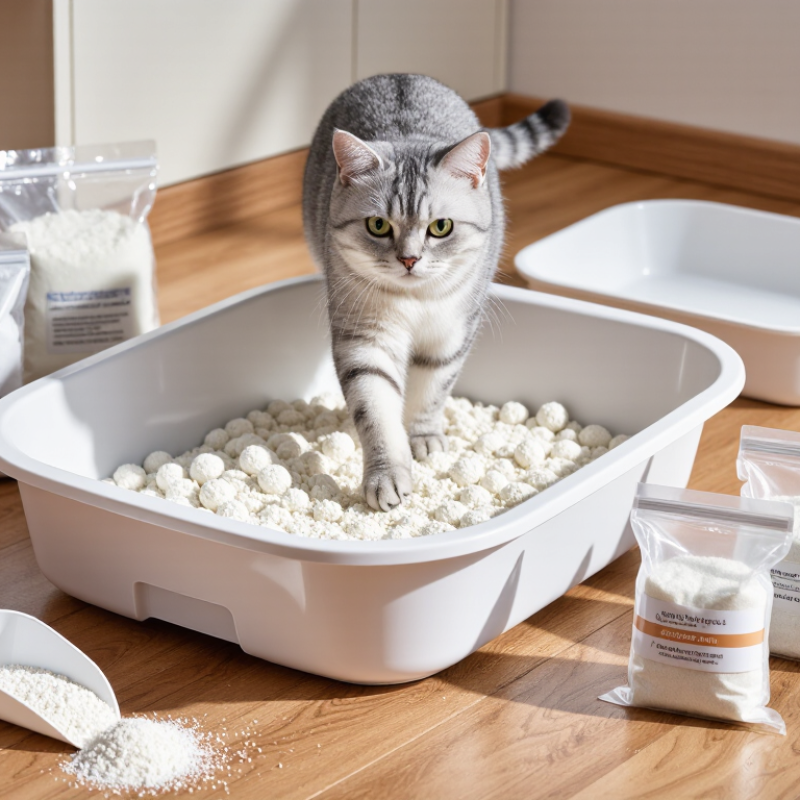
What Is White Bentonite Cat Litter?
White bentonite cat litter is a clumping litter made mainly from light-coloured montmorillonite clay. Its swelling structure absorbs urine and forms firm clumps. The white appearance usually reflects lower iron content and careful mineral selection, not automatically better performance. Sodium bentonite generally expands more than calcium bentonite, so it often provides stronger clumping. However, excessive expansion may increase tracking or create a heavier cleaning routine.
Industry data gives useful context. Grand View Research’s Cat Litter Market Size, Share & Trends Analysis Report estimates the global cat litter market at approximately US$5 billion in 2023, with continued growth expected through 2030. This demand encourages more suppliers in China, but market growth does not guarantee consistent quality. A reliable evaluation should check moisture content, dust percentage, absorption capacity, clump strength, granule size, and heavy-metal compliance through independent laboratory testing. Whiteness alone misleads. I would not select material by colour first.
Tips: Ask for a recent test report and a small sample. Pour 100 millilitres of water onto a thin layer. Check whether the clump forms quickly, stays intact, and leaves minimal wet residue. Also inspect dust after pouring from shoulder height. This test is simple, but it cannot replace laboratory analysis. That limitation matters.
| Evaluation Dimension | What White Bentonite Cat Litter Is | Typical Commercial Information | What to Look for in the Best Product |
|---|---|---|---|
| Main mineral | A cat litter made primarily from bentonite, a naturally occurring clay containing the mineral montmorillonite. | Commercial clumping litter commonly uses sodium-rich bentonite because it expands and gels when wet. | A clear mineral specification and a consistent clumping-grade raw material. |
| White appearance | The light color comes from the natural mineral composition and low levels of coloring impurities, especially iron-bearing minerals. | Color can range from off-white to pale gray or cream because bentonite deposits vary naturally. | A uniform, clean appearance without excessive dark particles or visible foreign matter. |
| Clumping performance | Water absorption causes the clay particles to swell and form a scoopable clump. | Performance depends on montmorillonite content, particle size, sodium activation, and processing. | Firm, fast-forming clumps that remain intact during scooping and do not break apart easily. |
| Absorption and expansion | Bentonite absorbs liquid by taking up water between its clay layers and expanding. | Absorption varies by deposit and formulation; supplier testing is needed for an accurate value. | High liquid uptake with limited wet residue at the bottom of the litter tray. |
| Granule size | Granule size affects tracking, dust, drainage, comfort, and clump formation. | Common commercial grades include fine, medium, and coarse particles; exact ranges differ by supplier. | A balanced particle distribution with enough fine particles for clumping but not excessive powder. |
| Dust level | Dust is made up of very small mineral particles released during mining, drying, crushing, and filling. | “Low dust” is not a universal measurement and should be supported by a defined test method or test result. | Screened granules, controlled fines, and packaging that limits powder separation during transport. |
| Odor control | Bentonite mainly controls odor by quickly encapsulating urine and feces in removable clumps. | Odor performance also depends on litter depth, ventilation, cleaning frequency, and optional additives. | Fast clumping, effective liquid isolation, and a neutral or clearly disclosed fragrance formulation. |
| Moisture content | Moisture content indicates how much water remains in the finished mineral product. | The actual value varies with drying conditions and must be confirmed by a batch test or certificate of analysis. | A stable, supplier-declared moisture specification with consistent results between batches. |
| Tracking potential | Small or lightweight granules may stick to paws and be carried outside the litter box. | Tracking depends on granule shape, size distribution, cat behavior, and the use of a litter mat. | Rounded or medium-to-coarse granules that reduce paw adhesion without sacrificing clumping. |
| Safety and cleanliness | Bentonite is a mineral litter material, but cats and people can be exposed to dust during pouring and scooping. | Product safety depends on mining controls, screening, additives, packaging, and quality management. | No undisclosed additives, clean packaging, batch traceability, and independent testing where required. |
| Best overall selection | The best product is not determined by whiteness alone. | Quality can vary between deposits, processing lines, particle grades, and production batches. | Choose a consistently white, low-dust, fast-clumping litter with reliable test data, suitable granules, and transparent ingredient information. |
Note: Bentonite properties vary naturally and by processing method. Absorption, moisture, dust, and clumping claims should be verified against the specific product specification and batch test results.
It is clumping litter made mainly from pale montmorillonite clay. The clay absorbs urine and forms removable clumps.
No. Whiteness often indicates lower iron content, not stronger absorption. Colour can mislead.
Sodium bentonite generally expands more than calcium bentonite. Excessive expansion may increase tracking and cleaning effort.
Producers select pale ore, then crush, dry, mill, and granulate it. Screening creates different particle sizes.
Request moisture, montmorillonite content, swelling volume, dust level, particle distribution, and clump strength. Ask for recent laboratory results.
Pour 100 millilitres of water onto a thin litter layer. Check formation speed, clump strength, wet residue, and dust.
Use identical trays, litter depths, and liquid volumes. Record clumping time, odour after 24 hours, dust, and floor tracking.
No. Temperature, granule shape, and storage humidity can change results. A practical trial remains necessary.
Check sealed bags, batch consistency, loading moisture, and storage instructions. Moisture can weaken or alter the granules.
No. Compare performance, consistency, handling, and test evidence before price. I might still be wrong after one sample.
White Bentonite Cat Litter is a clay-based cat litter valued for its strong absorbency, effective clumping, and light color. China produces this material through careful mining, drying, crushing, screening, and grading processes, with product quality often determined by particle size, moisture level, clumping strength, dust content, and absorption performance. The best products should form firm, easy-to-remove clumps while helping control odors and keeping the litter box comfortable for cats.
When comparing Chinese White Bentonite Cat Litter, buyers should evaluate consistency, low-dust performance, granule texture, packaging quality, shipping suitability, and available customization options. It is also important to consider a cat’s age, sensitivity, paw preferences, and bathroom habits. A balanced choice should provide reliable clumping and odor control without producing excessive dust or creating an unpleasant texture. By comparing technical specifications and matching them with the cat’s needs, owners can select a practical and dependable White Bentonite Cat Litter for everyday use.