Choosing the right Clumping Bentonite Cat Litter supplier in 2026 requires more than comparing prices. Product consistency, mineral sourcing, dust control, and export reliability can shape daily cat care and retailer performance.
Industry data shows why this category deserves closer attention. The American Pet Products Association’s 2024–2025 National Pet Owners Survey confirms strong and sustained cat ownership in the United States. Meanwhile, Grand View Research and Mordor Intelligence both identify continued growth in the global cat litter market, although their market estimates differ by methodology and coverage. That difference matters. Market numbers are useful signals, not unquestionable facts.
This guide examines leading suppliers through practical purchasing criteria. These include bentonite absorption, clump strength, particle size, odor control, packaging quality, and documented quality management. We also consider production capacity, private-label support, port access, certifications, and customer feedback. A bright package does not guarantee reliable performance. Neither does a low quotation.
Real-world testing remains essential. A strong clump should lift cleanly from the tray without turning into wet crumbs. Dust should remain limited when the bag is poured. Some suppliers publish impressive specifications, but independent samples may tell a different story. That is an uncomfortable gap.
The following supplier overview combines available industry research, manufacturer information, and buyer-focused evaluation. It does not treat any company as automatically superior. Instead, it highlights where each supplier may fit different markets, budgets, and quality expectations. Details matter. So does verification.
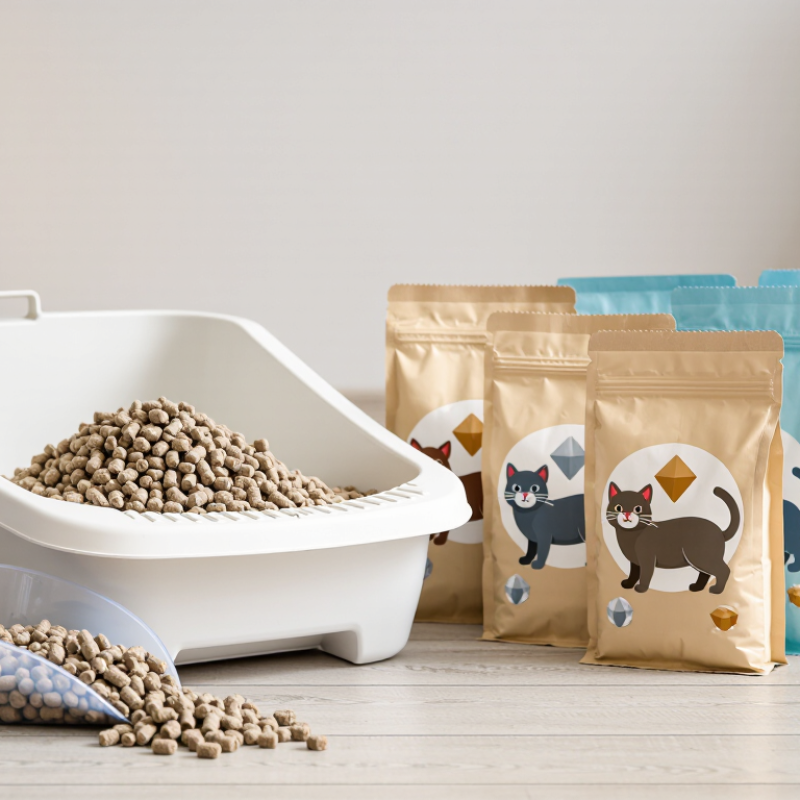
Clumping bentonite cat litter is a mineral-based litter made from absorbent clay. Sodium bentonite expands when it contacts moisture. Clumps form quickly. This reaction binds urine into compact pieces, while the remaining litter stays relatively dry. Owners can remove the soiled area daily instead of replacing the entire tray. That can reduce waste and keep the box fresher between complete changes.
In practical use, texture matters. Fine granules usually form tighter clumps, but they may create more dust during pouring. Larger granules can track less, though some cats dislike their feel. A low-dust, unscented formula is often a sensible choice for sensitive cats and households. However, no litter performs perfectly in every tray. Weak clumps may break apart when the layer is too shallow or urine reaches the bottom. A depth of about seven to ten centimeters often supports better absorption, but each cat may need adjustment. I have found that slow pouring reduces airborne dust and prevents uneven distribution. Scooping twice daily also limits odor more reliably than strong fragrance. Bentonite litter should not be flushed, because swelling clay may block plumbing. Dispose of used litter according to local waste guidance, and watch for coughing, irritated paws, or sudden tray avoidance.
Clumping bentonite cat litter is made primarily from sodium-rich bentonite, a clay containing montmorillonite. When wet, its particles absorb liquid, swell, and bind together into removable clumps. The chart below presents common technical benchmarks used when evaluating bulk bentonite cat litter materials; it does not compare individual companies or brands.
Typical values vary with mineral composition, particle size, processing, and test method. Swelling capacity is commonly reported as milliliters per 2 grams, while cation-exchange capacity is reported as milliequivalents per 100 grams.
How to Evaluate Bentonite Cat Litter Suppliers in 2026
Demand is becoming harder to satisfy consistently. The American Pet Products Association reported that 66% of U.S. households owned a pet in 2023–2024, supporting steady litter consumption. Grand View Research also identifies clumping litter as a major market segment, with continued growth expected through the decade. These figures do not prove supplier quality. They only show why careful screening matters.
Evaluate the mineral before discussing price. Ask for sodium bentonite origin, particle-size distribution, moisture content, and absorption results from an independent laboratory. Test clump strength after ten minutes, not only immediately after wetting. Check dust levels during pouring, because a clean warehouse sample can hide transport damage. Small details matter. Request recent certificates of analysis, safety data sheets, batch numbers, and documented quality limits. A reliable supplier should explain rejected-batch procedures without hesitation.
Production evidence is equally important. Review mine traceability, processing controls, packaging tests, and shipment records. Compare three batches, not one. The International Organization for Standardization emphasizes documented quality systems, but certification alone cannot replace product testing. This is where evaluation can become imperfect. A low-dust sample may perform poorly in humid storage. A strong clump may create excessive tracking. Ask for pilot shipments and inspect bags, pallets, odor, and fines after handling. The best supplier is not always the cheapest; it is the one that can repeat acceptable performance when conditions change.
Supplier evaluation benchmark for private-label and wholesale buyers. The figures below are practical commercial target ranges and should be confirmed through laboratory testing, audits, samples, and contract documentation.
| Evaluation Dimension | Recommended 2026 Benchmark | How to Verify | Why It Matters | Priority |
|---|---|---|---|---|
| Bentonite Type | Sodium bentonite or sodium-activated bentonite designed for rapid clumping. | Request mineral composition, activation details, product specification, and an independent test report. | Sodium bentonite generally provides stronger swelling and clumping performance than untreated calcium bentonite. | High |
| Liquid Absorption | Target at least 300% water absorption by weight; compare all samples using the same test method. | Conduct a controlled laboratory or in-house absorption test and record the test standard used. | Higher absorption can improve odor control, reduce consumption, and support firmer clumps. | High |
| Clump Formation | Firm clumps that form quickly and remain intact during scooping; a practical target is a short setting time of approximately 15–60 seconds. | Test equal quantities with a consistent liquid volume, waiting time, scoop design, and evaluation score. | Weak or slow clumping increases litter waste and creates cleaning problems for consumers. | High |
| Moisture Content | Preferably no more than 10% at packing, subject to the agreed product specification. | Use an oven-drying or moisture-analyzer test on samples from different production lots. | Excess moisture may reduce absorbency, cause premature clumping, and increase shipping weight. | High |
| Granule Size | Common cat-litter grades are approximately 0.5–2.0 mm; finer or coarser grades should be selected for the intended formula. | Check sieve-analysis results and compare the actual particle distribution with the purchase specification. | Particle size affects tracking, dust, paw comfort, absorption speed, and product appearance. | High |
| Dust Performance | Set a measurable low-dust limit, commonly below 1% for a defined particle-size test, rather than relying on marketing claims. | Request the supplier's dust-test method and perform a pour, shake, or gravimetric comparison on sealed samples. | Low dust improves user acceptance and helps reduce airborne particles during pouring and scooping. | High |
| Odor Control | Evaluate the untreated mineral first; activated-carbon, zeolite, or fragrance options should be separately specified. | Run a blinded odor test using identical litter depth, urine formulation, ventilation, and observation time. | Odor performance depends on both mineral properties and additives, so supplier claims need controlled testing. | High |
| Bulk Density | A practical commercial comparison range is approximately 0.75–0.95 g/cm³, depending on granule size and processing. | Measure mass and volume using a calibrated container and use the same filling and leveling procedure. | Density affects package size, freight cost, pouring behavior, and the perceived value per bag. | Medium |
| Heavy Metals and Contaminants | Require compliance with applicable destination-market limits for lead, arsenic, mercury, cadmium, and other regulated contaminants. | Obtain a recent independent certificate of analysis for the exact product and production site. | Mineral products require documented contaminant control to support product safety and market access. | High |
| Microbiological Quality | Require documented limits for total bacterial count, yeast, mold, and pathogens where applicable. | Review batch-specific laboratory reports and the supplier's hygiene and storage procedures. | Although bentonite is inorganic, contamination can occur during processing, storage, or packing. | Medium |
| Packaging Options | Offer moisture-resistant bags with clear net weight, lot code, production date, usage instructions, and disposal guidance. | Inspect packaging samples, drop-test results, seal strength, palletization, and artwork-control procedures. | Packaging protects product performance and reduces leakage, moisture uptake, and retail complaints. | High |
| Minimum Order Quantity | Confirm separate MOQs for bulk material, standard bags, custom packaging, fragrance, and private-label artwork. | Request a written quotation showing MOQ by SKU, packaging format, and customization level. | Different MOQ rules can materially change inventory risk and landed cost for new product launches. | High |
| Sample and Pilot Process | Supplier should provide representative samples from production material and support a pilot order before full-scale purchasing. | Compare pre-shipment samples, pilot samples, and final goods using a documented approval checklist. | Sample consistency is one of the clearest indicators of process control and supply reliability. | High |
| Quality Management | Documented incoming-material, in-process, final-product, and batch-release controls; ISO 9001 certification is a useful supporting indicator. | Review certificates, inspection records, corrective-action procedures, and audit the relevant production site. | A quality system reduces variation in clumping, moisture, dust, packaging, and shipment documentation. | High |
| Traceability | Every shipment should be traceable to raw material, processing date, production line, test results, and packing lot. | Ask for a sample batch record and verify that the lot code appears on both inner and outer packaging. | Traceability supports recalls, complaint investigation, and consistent replenishment. | High |
| Production Capacity | Assess confirmed monthly capacity, peak-season allocation, reserve capacity, and lead time for the exact SKU. | Request a capacity statement, production schedule, lead-time history, and shipment performance data. | Nominal factory capacity does not guarantee availability for a specific formula or packaging format. | Medium |
| Lead Time | For established specifications, a common planning range is approximately 15–45 days after order and artwork approval; confirm case by case. | Compare quoted lead time with historical on-time delivery records and include inspection time in the plan. | Reliable lead times help prevent stockouts, emergency freight, and retail service failures. | High |
| Export Documentation | Supplier should consistently provide commercial invoice, packing list, certificate of origin where required, safety documentation, and test reports. | Review a redacted document package from a previous shipment and confirm destination-country requirements. | Correct documents reduce customs delays and support regulatory and retailer compliance. | High |
| Landed-Cost Transparency | Compare material, additives, packaging, palletization, inspection, inland transport, ocean freight, duties, and destination charges separately. | Request both an ex-works or FOB quotation and a delivered-cost calculation using the same volume and Incoterm. | The lowest unit price may not provide the lowest total cost after freight, waste, and quality claims. | High |
| Commercial Reliability | Use a written specification, change-notification clause, sample-approval requirement, claim procedure, and agreed inspection standard. | Review the sales contract, quality agreement, warranty terms, and response-time commitments. | Clear commercial controls protect the buyer when mineral quality, packaging, or delivery performance changes. | High |
2026 Top Clumping Bentonite Cat Litter Suppliers?
Reliable suppliers should provide clear evidence behind every quality claim. Their bentonite source, processing site, and batch number should be traceable. Consistent clumping matters because weak lumps leave wet granules behind. That creates extra cleaning and unpleasant odors. Ask for laboratory results covering moisture, dust, particle size, and absorption performance. I would also test several batches, not just one attractive sample. Real household use can expose differences that certificates miss.
Safety standards require more than a general “natural” statement. Suppliers should provide current safety data, handling guidance, and contaminant screening from qualified laboratories. Low-dust processing is important for cats, owners, and workers. Packaging should remain sealed during transport and storage. Clear labeling builds trust. Claims should match test evidence, not marketing language. Some suppliers still use vague sustainability terms, which deserve careful questioning.
Sustainability should include responsible mineral extraction, efficient water and energy use, and practical packaging choices. Ask whether the supplier measures waste and maintains environmental permits. Independent audits can strengthen credibility, but audit scope matters. A small audit may not cover the whole supply chain. I would request corrective-action records when problems appear. No supplier is perfect. Honest reporting, stable specifications, responsive communication, and continuous improvement often reveal more reliability than polished sales materials.
2026 Top Clumping Bentonite Cat Litter Suppliers?
Supplier regions increasingly shape product consistency, freight costs, and environmental reporting. The United States remains a major bentonite producer, with Wyoming and Montana supporting large-scale sodium bentonite extraction. Turkey, China, and India also provide substantial mineral-processing capacity. USGS Mineral Commodity Summaries 2025 identifies bentonite as an established industrial mineral, used heavily in absorbent applications and drilling. Cat litter buyers should still verify mine location, reserve quality, and transport distance. A low quoted price can hide a long supply route.
Products now range from standard clumping granules to low-dust, fast-absorbing, and unscented formulations. Grand View Research’s 2024 cat litter analysis valued the global market at more than US$10 billion, while noting continued demand for convenient clumping formats. Reported market estimates differ, so supplier claims deserve careful checking. Ask for particle-size distribution, moisture content, swelling performance, dust results, and batch traceability. Good manufacturers use sodium activation, controlled drying, multi-stage screening, and sealed packing lines. They should also provide laboratory certificates, not only marketing samples.
Production scale matters, but it is not everything. A supplier may handle twenty-ton shipments yet struggle with consistent granule strength. That happens. Request three consecutive batch samples and compare scoopability, odor retention, and tracking on a clean floor. Independent testing is sensible, especially when private specifications are strict. Regional capacity, technical documentation, and honest limitations together offer a more reliable supplier picture.
Choosing the right clumping bentonite cat litter supplier requires more than comparing price per tonne. Grand View Research values the global cat litter market at about USD 10.8 billion in 2023, with projected growth near 4.8% annually through 2030. The American Pet Products Association reported that 66% of U.S. households owned a pet in 2023–2024. Demand is large. Quality failures are costly.
Ask suppliers for recent test reports, production photos, and batch-level certificates of analysis. Check sodium bentonite content, clump formation, absorption rate, dust level, odor control, and moisture resistance. Test litter in real trays for at least two weeks. A firm clump should form quickly without sticking heavily to the base. Packaging also matters. Weak bags can absorb humidity during ocean transport. Review minimum order quantities, lead times, private-label capability, and backup production capacity. Supplier audits are useful, but one visit cannot prove long-term consistency. I have seen attractive samples perform differently after bulk delivery.
Tips: Request three independent samples from separate batches. Weigh dust after pouring. Record clump size and drying time. Ask how rejected material is handled. Compare landed cost, not factory price. Confirm export documents and product specifications before payment. A cheaper supplier may create higher return rates. That calculation is often missed. Consider quarterly laboratory testing, especially when changing mines, formulas, or packaging.
It is mineral-based litter made from absorbent clay. Sodium bentonite expands when wet and forms compact clumps.
Urine becomes a removable solid piece while surrounding granules stay fairly dry. Scoop the soiled area daily. Less litter is discarded.
Fine granules usually create tighter clumps but may produce more dust. Larger granules can reduce tracking, though some cats dislike their texture.
A layer around seven to ten centimeters often supports better absorption. A shallow layer may produce weak clumps or wet tray bottoms.
Pour slowly and avoid dropping the litter from a height. Choose low-dust, unscented material for sensitive cats and households.
Scooping twice daily usually controls odor better than relying on strong fragrance. Complete tray changes still require regular scheduling.
Request mineral origin, particle-size data, moisture content, absorption results, batch numbers, and recent laboratory certificates. Compare at least three batches.
Test clump strength after ten minutes, not only immediately after wetting. Inspect dust, odors, broken bags, pallets, and fine particles after transport.
Ask for current safety documents, contaminant screening, mine traceability, processing controls, and environmental records. Vague “natural” claims need evidence.
No. Swelling clay may block plumbing. Dispose of used litter according to local waste guidance, and watch for coughing, irritated paws, or tray avoidance.
This guide explores what makes Clumping Bentonite Cat Litter an effective choice for modern cat care and commercial distribution. It explains how natural bentonite absorbs moisture, forms firm clumps, helps control odors, and supports easier daily cleaning. For businesses evaluating suppliers in 2026, the article focuses on practical criteria such as mineral quality, consistent particle size, clumping performance, dust control, packaging flexibility, production capacity, and reliable delivery.
It also outlines key standards for product safety, quality assurance, environmental responsibility, and transparent sourcing. Readers will learn how supplier regions, processing technology, private-label capabilities, and customization options can affect cost and performance. By comparing certifications, testing procedures, minimum order quantities, communication, and long-term supply stability, cat litter businesses can identify a suitable partner that meets customer expectations while supporting responsible and sustainable growth.